 Advertorial
Advertorial
Advertorial
Product Review
We analyzed the ingredients, dosages, research and formula design behind Cortisol Balance. Here’s what stood out.
People who feel tired but wired, struggle to properly switch off after stressful days, or want something more complete than magnesium or ashwagandha alone.
Hormoona doesn’t build the entire formula around one “cortisol ingredient.” Instead, five ingredients have five different roles across cortisol support, mental calm, nervous-system function and stress resilience.
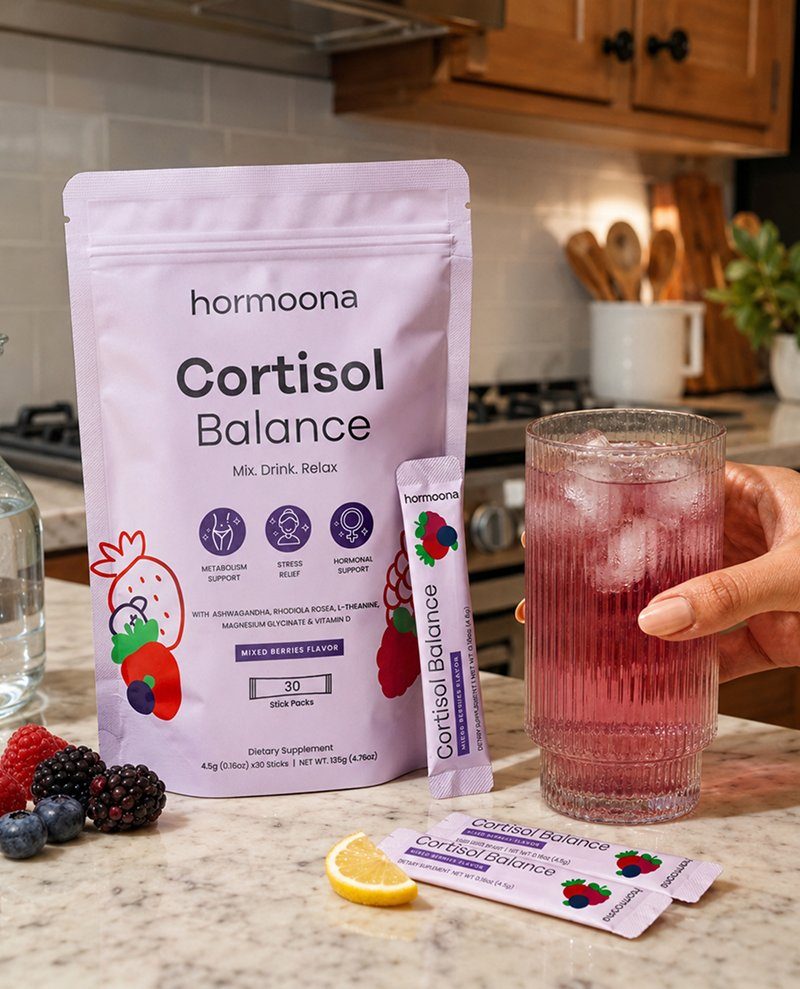
There are a lot of cortisol supplements now, and most aren’t difficult to understand. Some are essentially ashwagandha supplements. Others are magnesium formulas. An increasing number are simply relaxation powders repackaged around the word “cortisol.”
Cortisol Balance is different. Hormoona’s formula is built around a simple idea:
Instead of asking ashwagandha or magnesium to do everything, Hormoona combines five ingredients that play different roles:
That may sound like a small distinction. After reviewing the research, we think it’s the strongest thing about the product. Hormoona isn’t impressive because it crammed the most ingredients into a stick — it didn’t. It’s impressive because the ingredients make sense together.
A once-daily powdered cortisol-support supplement in individual sticks: five active ingredients, zero sugar, and a deliberately short ingredient list rather than a large proprietary-style blend.
The company recommends taking it as an afternoon or early-evening routine, around 5–7 p.m. Why that time is one of the more interesting parts of this formula — we’ll come back to it.
Cortisol isn’t bad. You need it. If your goal were simply to make cortisol as low as possible all day, you’d be misunderstanding what the hormone does.
Cortisol follows a daily rhythm: it typically rises around waking to prepare the body for the day, then gradually declines toward evening. So the better question isn’t “How do I eliminate cortisol?” It’s:
That distinction becomes more relevant with age. Research on endocrine aging describes a tendency toward higher late-day cortisol, reduced circadian amplitude and more irregular secretion patterns in older adults — which gives us a much more useful way to think about a familiar pattern:
Tired when you need energy. Wired when you want to relax.
That’s exactly the pattern Hormoona’s formula appears designed around.
| Ingredient | Amount | Primary Role |
|---|---|---|
| KSM-66® Ashwagandha | 400 mg | Cortisol + stress-response support |
| L-Theanine | 300 mg | Mental calm |
| Magnesium Bisglycinate | 300 mg | Nervous-system + relaxation support |
| Rhodiola Rosea | 300 mg | Stress adaptation + resilience |
| Vitamin D3 | 1,000 IU | Foundational nutritional support |
If one ingredient here has the strongest direct claim to the word “cortisol,” it’s ashwagandha. And Hormoona isn’t using an unidentified generic botanical powder — it uses KSM-66®, a standardized root extract.
Ashwagandha has been tested in multiple randomized human trials. In one placebo-controlled study, stressed adults taking it for 60 days saw a significantly greater reduction in serum cortisol than placebo, and other randomized research has reported reductions in perceived stress and serum cortisol at 250 mg and 600 mg daily.
More importantly, this is no longer one isolated trial. A 2024 systematic review and meta-analysis found significant improvements in perceived stress, anxiety and serum cortisol versus placebo. Another meta-analysis also found a statistically significant cortisol reduction, while noting effects on perceived stress were less consistent.
Hormoona’s 400 mg sits within the range used across that literature — though individual studies differ substantially in extract, standardization and dosing. Which is the important caveat: you shouldn’t compare milligrams of every ashwagandha extract as if they’re equivalent. Form matters. Standardization matters.
If we were designing a cortisol formula, a well-characterized ashwagandha extract would be one of the first ingredients we’d want. Hormoona gets that right.
This is where the formula gets more interesting. Because stress isn’t always “I feel anxious.” Sometimes you’re exhausted, you finally sit down — and your mind keeps going. Tomorrow’s schedule. Something someone said. An email you forgot. One more scroll, one more thought, one more thing.
A randomized, triple-blind crossover trial tested 200 mg L-Theanine during an acute stress challenge. Versus placebo, it was associated with changes in brain alpha activity and a greater decrease in salivary cortisol afterward. Another randomized study using 200 mg/day for four weeks reported improvements in several stress-related measures and components of sleep quality.
Hormoona contains 300 mg — not a decorative amount thrown onto the label. And this is where the combination starts making sense: ashwagandha is the primary cortisol-support ingredient, while L-Theanine addresses the mental activity that keeps the stress response switched on.
One of the strongest parts of the formula.
Strategically, this might be the ingredient we like most — because there’s a contradiction at the heart of many cortisol products. The customer is already exhausted, and the solution is often “here are four things to make you even more relaxed.” That works at bedtime. It doesn’t work for someone whose problem is tired AND wired.
Rhodiola is an adaptogenic botanical studied around stress-related fatigue, performance under stress and adaptation. In a randomized, double-blind, placebo-controlled trial in people with stress-related fatigue, a standardized extract produced significant improvements in several fatigue and attention measures versus placebo, and researchers also found differences in cortisol awakening response. Other randomized trials have reported improvements in mental fatigue and performance during stressful periods.
The evidence base isn’t as clean or extensive as we’d like, and we wouldn’t call Rhodiola a proven “cortisol reducer.” Its role here is balance — positioned around stress resilience rather than as a stimulant or another sedating ingredient. That gives the product a stronger conceptual structure:
Excellent fit within the formula. The clinical evidence is simply less robust than ashwagandha’s.
Magnesium is the most familiar ingredient here, and for good reason: it’s involved in normal nervous-system and muscular function, and has become one of the most commonly used supplements for relaxation and sleep.
A 2024 systematic review examined 15 magnesium intervention trials focused on sleep or anxiety. Five of eight studies measuring sleep outcomes reported improvements, as did five of seven examining anxiety outcomes — though the authors emphasized that studies varied considerably in formulation, population, dose and quality, limiting firm conclusions.
That’s roughly how we view magnesium here. Useful? Yes. The entire solution? No. Many people looking for stress support already own magnesium; some feel noticeably better on it, others don’t. Hormoona doesn’t need to argue magnesium is useless — quite the opposite, it’s useful enough to include. But expecting one mineral to handle cortisol, mental overactivity, nervous-system support and stress adaptation simultaneously is asking too much of one ingredient.
One important labeling detail. The product materials list 300 mg Magnesium Bisglycinate. The weight of a magnesium compound and the amount of elemental magnesium it supplies aren’t necessarily the same number.
Hormoona’s own competitor research warns against comparing magnesium milligrams across brands unless they’re expressed on the same basis. So before making any “3× more magnesium than X” comparison, check the Supplement Facts panel.
A smart inclusion — more valuable as part of this formula than as the formula’s entire story.
Vitamin D3 isn’t the reason we’d buy Cortisol Balance — and that’s fine. We prefer formulas where every ingredient isn’t forced into an exaggerated cortisol story.
Vitamin D is an essential nutrient involved in numerous functions throughout the body. Hormoona includes 1,000 IU as broader nutritional support, and it has a logical relationship with magnesium, which participates in vitamin D metabolism. But the formula is still primarily defined by the other four. Vitamin D rounds it out.
Useful. Sensible. Not overcomplicated.
Supplement companies love ingredient lists. Eleven sounds more advanced than five; seventeen sounds better still — until you ask why each one is actually there.
That’s where Hormoona scores unusually well. Five principal ingredients, and you can explain the whole formula in about 20 seconds:
Hormoona’s competitive research identified this as one of the category’s strongest opportunities: be more complete than single-ingredient products without becoming a “kitchen sink” formula nobody can decode. We agree.
This is the most important question in the review, because standalone ashwagandha is cheap — you can buy KSM-66® capsules.
The answer isn’t “ashwagandha doesn’t work.” It’s one of the best-supported ingredients in the formula. The better question is what you’re expecting it to do. Ashwagandha doesn’t replace magnesium, doesn’t perform the same function as L-Theanine, and its role isn’t identical to Rhodiola. Same logic for magnesium: if it’s already doing exactly what you want, you may not need a five-ingredient formula.
But many people arrive at cortisol supplements precisely because they’ve already tried magnesium, sleep supplements, melatonin, individual adaptogens, diet changes and more exercise — and still feel several issues happening at once. Hormoona’s customer research found exactly that pattern. The dominant frustration wasn’t “I’m stressed,” it was:
That’s the customer for whom Hormoona makes considerably more sense.
Here we’d separate serious cortisol science from TikTok cortisol science. Cortisol absolutely belongs in the conversation around stress, sleep, appetite, metabolic health and fat distribution. But:
Not every belly is a “cortisol belly.” Not every puffy face means cortisol is elevated. And no supplement can diagnose your cortisol level from your symptoms.
That doesn’t make the concept meaningless — it means the physiology is more complicated than a viral before-and-after video. Hormoona’s customer research does show stubborn abdominal weight and feeling physically “stuck” are major reasons people become interested.
Where the positioning gets it right is by looking at the whole pattern instead of one symptom: poor recovery, mental overactivity, sleep disruption, cravings, feeling tired but unable to switch off. That’s a much stronger reason to investigate stress regulation than “you have belly fat, therefore you have high cortisol.”
There’s nothing about ashwagandha, Rhodiola, L-Theanine, magnesium or Vitamin D that makes these ingredients intrinsically female-only, and much of the clinical literature includes men and women. Hormoona’s positioning and customer research were simply developed around women and how stress, cortisol and hormonal changes interact during midlife.
So the formula is broader than its original marketing avatar. Women in perimenopause, menopause and post-menopause are an especially relevant subgroup because changes in stress-response physiology become more noticeable then — but the mechanism makes sense for adults dealing with the tired-but-wired pattern generally.
At first we assumed this was branding. After looking closer, we like the idea.
Cortisol is generally supposed to be declining as the day progresses. And late afternoon is exactly when people transition from work, meetings, commuting, kids and emails into dinner, home, recovery and sleep. Except psychologically, that transition often doesn’t happen.
So Hormoona turns the supplement into a physical transition ritual:
But an important distinction: 5 p.m. isn’t a clinically proven “magic cortisol window” for this formula. There’s no randomized trial of the finished product comparing 5 p.m. against 8 a.m. or bedtime. The logic combines normal cortisol rhythm, avoiding a large drink right before bed, and creating a consistent cue that makes daily supplementation easy to remember. Practically, we think that beats telling someone “take whenever.”
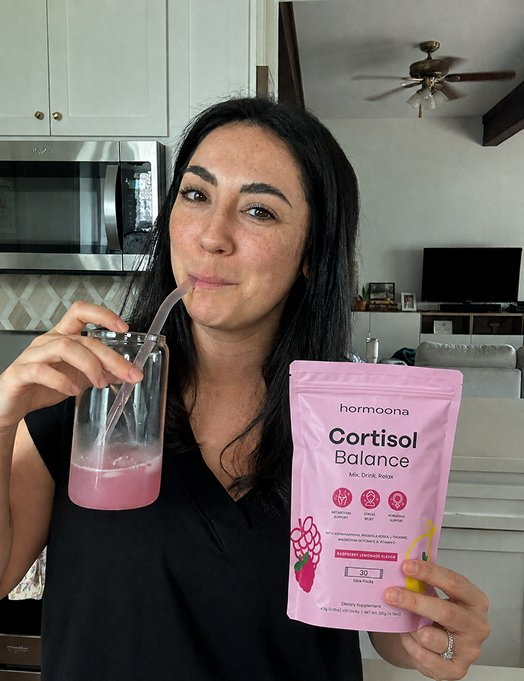
This sounds superficial. It isn’t — supplements only work when people actually take them. Hormoona comes in individual sticks: no scooping, no measuring, no six-bottle routine. One stick. Water. Done.
Competitor review analysis uncovered something worth noting: taste and ritual aren’t secondary to efficacy. Across reviews of competing cortisol products, unpleasant taste, excessive sweetness, poor dissolution and inconvenient routines repeatedly appeared as reasons people quit before they could evaluate longer-term effects. So portable single-serve sticks and multiple flavors aren’t just branding — they’re part of the adherence strategy.
Hormoona makes the most sense if several of these sound familiar:
If you’re already taking standalone ingredients that duplicate most of this formula and you’re happy with them, you’re paying primarily for convenience and formulation. If all you want is inexpensive magnesium, buy magnesium; if all you want is KSM-66®, a standalone version will cost less.
And if you’re expecting a supplement to erase chronic sleep deprivation or produce dramatic body-composition changes with nothing else changing — no cortisol supplement deserves that expectation. Hormoona’s case isn’t that it replaces sleep, nutrition or exercise. It’s that it gives you a more complete stress-support formula in one daily routine.
| Typical Approach | What It Does Well | What’s Missing |
|---|---|---|
| Ashwagandha alone | Direct cortisol/stress support | Mental calm, nervous-system and broader resilience strategy |
| Magnesium alone | Relaxation + nervous-system support | Complete cortisol/adaptogen approach |
| Sleep formula | Helps target nighttime symptoms | Often doesn’t address daytime stress resilience |
| Generic calm drink | Easy ritual + relaxation | Often weak cortisol-specific differentiation |
| Huge 10–20 ingredient blend | Looks comprehensive | Often harder to understand doses and ingredient roles |
| Hormoona Cortisol Balance | 5 complementary roles in one daily formula | Higher cost than buying one ingredient alone |
If the formula were 400 mg KSM-66® plus four trace ingredients, we’d be far less impressed. Instead, Hormoona gives meaningful prominence to L-Theanine and Rhodiola alongside its ashwagandha foundation. We wouldn’t describe it as “ashwagandha plus extras” — we’d call it a multi-pathway stress-support formula built around ashwagandha.
This is another area where cortisol supplements tend to oversell. L-Theanine has been studied acutely. Ashwagandha studies examining cortisol and perceived stress typically run several weeks — commonly 6–8 — rather than one or two doses. Rhodiola trials have similarly evaluated repeated supplementation over weeks.
So we wouldn’t judge the formula on “did my belly change after five days?” A more sensible framework is to watch these first:
Then evaluate slower body-level changes separately. Hormoona’s own review research found calm and better sleep tend to be the most believable early wins, with body-level changes expected later. That expectation makes sense.
For generally healthy adults the individual ingredients are commonly used in supplements — but “natural” doesn’t mean universally appropriate. Ashwagandha and Rhodiola are biologically active botanicals and individual responses vary. People taking medication, managing medical conditions, pregnant or breastfeeding should be particularly cautious about adding concentrated herbal extracts without checking with a qualified clinician.
We’d also judge tolerability by actual experience. If a product consistently makes you feel worse, unusually stimulated or sedated, excellent ingredients on paper aren’t a reason to keep forcing it. That’s true of Hormoona and every competing supplement.
After going ingredient by ingredient, the reason Hormoona stands out isn’t complicated: most cortisol supplements ask one ingredient to do too much.
Ashwagandha is useful, and it’s here. Magnesium is useful, and it’s here too. L-Theanine makes sense when mental overactivity is part of the problem. And instead of building everything around “calming down,” Hormoona adds Rhodiola for the stress-resilience side. Then packages it in one daily stick — no 17-ingredient proprietary blend, no pretending one mineral controls the entire stress response, no building your own stack from five bottles.
Five ingredients. Five distinct roles. One formula. And most importantly: the ingredients aren’t simply impressive individually — they make sense together.
Hormoona Cortisol Balance
CHECK PRICE & AVAILABILITY →NutraBenchmark may receive compensation when you purchase through links on our site. Our evaluations are our own.
Not exactly — it’s better described as a cortisol and stress-support formula. Some ingredients overlap with products used for relaxation and sleep, but the inclusion of Rhodiola is one reason we wouldn’t classify it as another bedtime sedative-style supplement.
The positioning is broader: calm enough to switch off, without designing the entire formula around making you sleepy.
Ashwagandha has human clinical evidence showing cortisol reductions in several randomized trials and meta-analyses. L-Theanine and Rhodiola have also been studied in relation to stress responses and cortisol in specific contexts.
The finished formula itself hasn’t been shown to have undergone a randomized clinical trial measuring cortisol. So: it contains evidence-backed ingredients intended to support healthy cortisol and stress response — not “every person who drinks it will have lower cortisol.”
If your only goal is taking ashwagandha inexpensively, probably not. If you want broader support across cortisol, mental calm, nervous-system function and stress adaptation, Hormoona is substantially more complete.
Be careful about doubling up without considering total intake. Cortisol Balance already contains magnesium bisglycinate, so your combined intake depends on the exact elemental magnesium supplied by each product.
Hormoona’s recommended ritual is roughly 5–7 p.m. — the transition between the active day and evening recovery. We like the ritual, though we wouldn’t claim 5 p.m. is clinically proven as the optimal dosing time for this exact formula.
Zero sugar. 30 sticks = 30 daily servings per pouch. Three flavors: Raspberry Lemonade, Mixed Berries and Peach Mango.
The assessment above draws primarily from human randomized trials and systematic reviews covering ashwagandha, L-Theanine, Rhodiola, magnesium and age-related cortisol physiology — including randomized ashwagandha trials measuring stress and cortisol, recent ashwagandha meta-analyses, controlled L-Theanine stress studies, Rhodiola stress-fatigue trials and a 2024 systematic review of magnesium supplementation for sleep and anxiety.
Editorial note: The 9.7/10 score is an editorial formula rating based on ingredient selection, research support, dose strategy, transparency, formula logic and convenience. It is not the result of a clinical trial comparing Hormoona against competing finished products. See our full methodology.